
Analysis of Prologue (1976) by Gérard Grisey
Introduction
The three versions of the piece
Prologue for solo viola was composed by Gérard Grisey between April and July, 1976. Dedicated to violist Gérard Caussé, the piece, as its name indicates, serves as the opening of the large-scale cycle, Les Espaces acoustiques, which the composer began—without, at the time, thinking of creating a cycle of works—with Périodes (1974) for seven instruments, followed by Partiels (1975) for 16 or 18 instruments. Subsequently, Prologue was composed in 1976, Modulations for 33 musicians in 1977–78, Transitoires for orchestra in 1980–81 and finally, Épilogue for four solo horns and orchestra in 1985.
With a duration of around 15 minutes, Prologue was conceived to merge smoothly into Périodes; a transitional passage appears shortly before the ending (starting in the seventh bar of the fifth system of the final page). Nonetheless, the work can be performed independently in any of the three existing versions, all of which use the same instrumental score:
- Prologue for solo viola
- Prologue for viola with acoustic resonators
- Prologue for viola and real-time electronics
The first two versions were premiered in 1978 by Gérard Caussé. In the latter of the two, the performer shares the stage with several resonator instruments which, through a complex technical setup, produce sympathetic resonances in response to certain frequencies emanating from the viola. Envisaged by Grisey but ultimately completed after his untimely death in 1998, the version with real-time electronics was created in 2000 at IRCAM by computer music designer Éric Daubresse and premiered the following year by violist Garth Knox. In this version, a computer simulates the sympathetic resonances in real time and diffuses them via loud-speakers.
In this analysis, we will discuss the two “mixed music” versions of Prologue, presenting in detail the notions of natural and virtual resonances (as they relate to the versions with acoustic resonators and real-time electronics, respectively).
- Version for solo viola
Premiered 16 January, 1978 in Paris by Gérard Caussé (viola)
- Version for viola and acoustic resonators
Premiered 7 August, 1978 at the Darmstadt Ferienkursen by Gérard Caussé (viola) and Gérard Grisey (sound engineer)
- Version for viola and real-time electronics
Premiered 3 April, 2001 at the Espace de projection, Ircam, Paris by Garth Knox (viola) and Éric Daubresse (computer music designer, sound engineer)
Notes de programme
** Prologue (1976) **
Essentially a melodic work, Prologue slowly drifts away from the sombre, hypnotic figures which characterise its opening. A single melodic cell based on the frequencies of a harmonic spectrum serves as the central axis around which the material gradually spirals outwards. Everything is derived from—and returns to—this cell, but never in the same way. The distinct essence, the Gestalt, the silhouette of the melody, as opposed to its constituent pitches, evolve as the harmonic spectrum becomes increasingly distorted, culminating in noise. This melodic silhouette also dictates the work’s structure, tempi and the placement of two “inserts”: a heartbeat (short–long) and orchestrated echoes.
Owing to its use of microtonality, Prologue is an immensely difficult work to perform (it is difficult enough to play a viola in tune at the best of times!). To this oneiric, melodious texture is added a series of responses from inert objects: sympathetic vibrations which emerge from the instruments surrounding the viola, like the sympathetic strings on a sitar or sarangui—with the distinction being that the resonating instruments used here cover a much broader acoustic range and can be controlled via electronic means.
A solo voice, phantom responses from passive instruments but also a structure which is abstract and unyielding; it is my hope that this work will represent an utterance of my vision of music: a dialectic between form and delirium.
Gérard Grisey [programme note, 2001]
** Prologue (2001) **
Performing Prologue using analogue means to achieve the desired electronic sounds has always been a cumbersome task. The difficulties of assembling the most effective resonator instruments, the long process of fine-tuning which requires the constant presence of the violist, the challenge of achieving a suitable balance, and the fragility, variable nature and lack of precision of the setup are significant hurdles. It is for these reasons that this version has only been performed a handful of times after its premiere. On several occasions, I expressed my wish to simulate this setup digitally, and Grisey was enthusiastic about the idea, in the hope that this would achieve the result that he had originally imagined. Given that I am intimately familiar with the piece (having worked on numerous recordings and performances of it), and that the technology we have today has reached a level of maturity whereby such a task can be performed using a single computer, it seemed to me that the time had come to create a new version which was less challenging to perform, in the sense that the acoustic resonator instruments were no longer required. The objective was also to guarantee the work’s survival and, in the absence of its composer, to ensure that past, “reference” versions were respected. The five resonators used in the first performance—i.e., the onde Martenot “palme” and metal gong, a piano, a tam-tam, and a snare drum—were analysed and modelled. Garth Knox recorded the viola part, and we used this in the studio. We then experimented with the digital setup, comparing it to the analogue version and meticulously following the composer’s indications. The developed electronics are based on the final annotated version of the score.
Éric Daubresse [Explanatory Text 1, 2001]
Solo viola, viola with resonators, viola with virtual resonators… Each version of Prologue explores, in its own way, the acoustic space [“espace acoustique”] resulting from the resonances of the work’s opening motif; the instrumentalist is compelled to adapt to this new “instrument.” For example, the sympathetic resonances reinforce certain notes and influence the durations of the fermatas; decisions regarding dynamics have to take this “virtual partner” into account; etc. As my own research on and experience with the viola d’amore have led me to study in detail the role of sympathetic strings, I was following with great enthusiasm the work being undertaken by Éric Daubresse on resonator modelling. Many hours of analyses and tests have given rise to the creation of a range of virtual resonances, which may be luminous, shimmering, dark or noisy in nature. In my opinion, it is significant that—thanks to this new version—Prologue, which is so innovative and beautiful, can be more widely performed and finally occupy the place that it deserves in the contemporary music canon.
Garth Knox [Explanatory Text 1, 2001]
Analysis of the technology used in the two versions with resonators
Both versions of Prologue with resonators are testimonies to the evolution of live performance of mixed music. In the first version, the sound of the viola, captured by microphones, is diffused via loud-speakers in order to cause various instruments—positioned behind the violist—to resonate in sympathy. In turn, these natural resonances are captured with microphones and amplified using additional loud-speakers in order to render these sounds audible. The setup required for this version, notwithstanding the instruments which act as resonators, is therefore a traditional form of amplification, requiring only microphones, loud-speakers, a mixing desk and, in some cases, a reverb module. The version with real-time electronics does away with the need for specific resonator instruments, and at the same time, overcomes a number of technical problems inherent to the amplification of sympathetic resonances. The setup is far simpler; it merely requires a computer running real-time signal processing software which is capable of producing the virtual resonances as well as, if necessary, artificial reverb.
Setup of the version with acoustic resonators
Sympathetic resonance
Sympathetic resonance is commonly associated with instruments or other objects which are inclined to begin resonating in response to vibrations diffused through the air. To observe such a phenomenon, one can simply depress the sustain pedal on a piano and then speak, or play a second instrument, at a reasonably loud volume. The strings on the piano will began to vibrate in sympathetic resonance, producing a light sonic “halo” with a mysterious quality. This phenomenon—which Luciano Berio and Pierre Boulez used in Sequenza X (1984) for trumpet and
Dialogue de l’ombre double (1985) for clarinet and tape, respectively—makes it possible to reinforce and prolong certain frequencies emitted by the primary sound source, thereby enriching the sound and creating an effect which is evocative of reverb. Several early-music instruments, such as the viola d’amore, as well as non-European instruments such as the sarangui (to which Grisey made reference in his programme note) feature additional strings which are never touched by the performer, but rather, resonate in sympathy, enhancing the sounds originating from the main strings. “I have always felt,” explains Grisey, “that the disappearance of sympathetic strings in Western music was a consequence of the extreme prevalence of polyphony. As such, there is no reason not to re-apply them in monodic works” [Grisey, 2008, p. 136].
Information in the composer’s sketches [Paul Sacher Stiftung] leads us to believe that Grisey had, from the outset, imagined that the instrumental material in Prologue would be enriched using sympathetic resonances. There was widespread interest in this phenomenon at the time; notably, Michaël Levinas had made use of it in Appels(1974) for 11 instrumentalists, in which the brass players perform in the vicinity of snare drums, causing the latter to resonate. The effect, according to Levinas, creates a “dramatic disruption” [Levinas, 2002, p. 69]. In contrast, the use of sympathetic resonance in Prologue is intended to bestow different colourations upon the sound, thereby reinforcing the work’s harmonic evolution.
Performances
Thus, to obtain resonances which would become increasingly inharmonic as the work progresses, Grisey tested several types of resonators in the studio, first with Patrick Lefant and later with Éric Daubresse, who worked with L’Itinéraire as technical assistants in the 1970s and 1980s, respectively. The choice of the five acoustic resonators did not change significantly during this testing phase or after the initial performances of the piece, given that certain instruments are more apt than others to generate sympathetic resonances, and that the intensities of these resonances had to be sufficient to allow them to be appropriately amplified.
In one of Grisey’s sketches, most likely created before work on the score of Prologue had been completed, the composer mentions the five following groups of resonators: (1) cello, viola and contrabass; (2) harp; (3) piano with the sustain pedal depressed with a weight; (4) a large tam-tam; and (5) a snare drum [Arch. Fondation Paul Sacher]. However, at the work’s premiere at Darmstadt on 7 August, 1978, the resonators used, according to Gérard Caussé, were a sitar [Figure 1], a harp, a piano, a tam-tam and a snare drum. The string trio which Grisey had imagined was apparently replaced by the Indian instrument, most likely for both practical and aesthetic reasons: it is far easier to amplify one instrument than three; and the cello, viola and contrabass typically generate only very soft sympathetic resonances. During the premiere, Grisey controlled the level of amplification of the sympathetic resonances from a mixing desk. In fact, the technical requirements posed numerous problems: setting up was onerous and the outcome was not what Grisey had envisioned, due to the instability and lack of precision of the used materials [Arch. Féron – Entretien avec Caussé].

Figure 1. Gérard Caussé (left) and Gérard Grisey (right) tuning a sitar, one of the five resonators used in the premiere of the mixed-music version of Prologue for viola and acoustic resonators at Darmstadt (7 August, 1978) [© Grisey, 2008].
This version of the piece was nonetheless performed again in Paris on 15 March, 1980. However, the programme note from this concert does not specify which resonators were used, and Patrick Lenfant, who was in charge of the technical setup, cannot recall the details [Arch. Féron – Interview with Lenfant]. Five years later, on 11 February, 1985, it was performed once again, this time in the Philharmonic Hall of the Liège Royal Conservatory. The five resonators in this performance were as follows: the “palme” and “metallic gong” of an ondes Martinot (designed by Maurice Martenot to enrich and sustain the sounds of the ondes Martenot), a piano, a tam-tam and a snare drum. Since that time, this has come to be regarded as the definitive setup. That being said, this version of the work has only been performed on two other occasions, both of which were overseen by Éric Daubresse: at a concert in Berlin in November, 1989, and for a recording at Radio France, on 20 December, 1991[EA CD Accord, 1993]. Daubresse recalled having experimented with Grisey with other resonators, notably a bass drum with marbles placed on the membrane; however, this idea was rejected shortly before the Berlin performance [Arch Féron – Entretien with Daubresse]. The aforementioned performances of Prologue with acoustic resonators are summarised in [Figure 2].

Figure 2. Details of the performances of the version of Prologue with acoustic resonators. The resonator instruments are presented in order of their appearance in the piece (based on information obtained from interviews with Daubresse, Caussé and Lenfant [Arch. Féron]).
Characteristics of the five resonators in the definitive version
The “palme” and “metallic gong” of an ondes Martenot, a piano, a tam-tam and a snare drum make up the five resonators required to perform the “definitive” version of the work.
In order for the piano to produce sympathetic resonances, the sustain pedal must be held down with a weight or a wedge. A loud-speaker through which the viola is amplified is then positioned below the soundboard of the piano, and microphones are placed above the strings to capture the resonances. The setup is similar for the tam-tam, i.e., an “exciter” loud-speaker is placed behind the instrument and a microphone in front. Likewise, a loud-speaker is placed beneath the snare drum (with snares ON) and a microphone above it.
In contrast, it is not necessary to use an additional loud-speaker with the ondes Martenot resonators, as they are already equipped with their own transducers. The “palme” comprises a resonant body with two identical sets of twelve strings [Figure 3]. A contact-transducer is attached to the body, allowing vibrations to effectively disseminate through it, subsequently setting the passive strings in motion. These strings can be tuned as required. In the case of Prologue, frequencies of the harmonic spectrum of E0 (with a fundamental of 41.2 Hz) were used. Nonetheless, the tessitura of the “palme” is relatively narrow, and certain frequencies, i.e., corresponding to harmonics 7, 9 and 11, had to be transposed down one octave. The second and third harmonics (i.e., one octave and an octave + a fifth above the fundamental) were doubled in order to strengthen their presence.

Figure 3. Ondes Martenot “palme” and the pitches to which the two sets of passive strings are tuned in Prologue: the pitches coincide with harmonics 2, 3, 4, 5, 6, 7, 9 and 11 of a harmonic spectrum with E0 as its fundamental. Harmonics 7, 9 and 11 are transposed down by one octave, as indicated with arrows.
The ondes Martenot “metallic gong” [Figure 4] generates extremely rich resonances. An electromagnetic transducer is permanently attached to the gong itself; the contact area between the gong and the transducer is as small as possible in order to minimise the damping effect that the latter would have. “It was also necessary to choose the optimal position to attach the transducer so that the gong would vibrate as much as possible, and then permanently attach it with a screw in that position,” recalls Laurendeau [1990, p.102].

Figure 4. Ondes Martenot “metallic gong.”
The various resonators are more or less readily set in motion by an external sound source, based on the distribution and intensities of the frequencies contained therein. Owing to the tuning of the “palme” applied in Prologue, its resonances are perfectly harmonic. In contrast, the piano, which is tuned in equal temperament, resonates with slightly inharmonic sounds; as such, any tempered interval played by the violist will result in resonance. The “metallic gong” and the tam-tam produce resonances which are far more inharmonic, creating a halo of distortion around the sound of the viola. Finally, the snare drum produces a hissing sound which is extremely complex from a spectral point of view. The choice of resonators and the order in which they appear in the first part of the work are based on the process of transformation of the instrumental material: initially harmonic, it becomes increasingly inharmonic, culminating in noise [Figure 5].

**Figure 5. Waveform and sonogram [Fréquence : 0-7 kHz ; Temps : 0-14 min] of Porlogue for viola and acoustic resonators [EA CD Accord, 1993]. Beyond an overall increase in intensity and brilliance, the process of harmonic distortion in the instrumental material can be observed. In the beginning, equidistant points on the vertical axis reveal the harmonicity of the material. However, very quickly, these points become stretched out, forming vertical lines which are indicative of increasing degrees of inharmonicity, culminating in saturated noise. **
Technical problems
The remarkably modest number of performances of the version of Prologue with acoustic resonators is a result of the complexity and fragility of the technical setup. The sound from the viola, picked up by microphones, must be directly diffused via one or more loud-speakers positioned in close proximity to each resonator instrument, or in the case of the ondes Martenot instruments, via the built-in transducers. In this way, the sympathetic resonances “colour,” each in their own way, the sound of the viola. The choice of these particular resonators was based on their propensity to enter into resonance. At the work’s premiere in Darmstadt, the string trio was replaced with a sitar, although this instrument, like the harp, was later rejected, as the resonances it produced were too soft to be satisfactorily amplified. For resonators to produce sound, the exciter signal must be reasonably loud; however, if it is too loud, feedback occurs. As such, the balance in terms of amplification is extremely delicate. Below is a summary of the technical and logistical problems associated with the performance of this version of Prologue :
- Procuring the resonators.
As with all mixed music, Prologue requires materials of extremely high quality. Additionally, it is necessary to obtain the five resonators, of which the components from the ondes Martenot are particularly hard to come by.
- Capturing the sound of the viola.
At the time in which the version of the piece with acoustic resonators was being performed, DPA-type or contact microphones [Figure 7] existed but could not be attached without the risk of damaging the instrument, as the attachment mechanism comprised little more than double-sided adhesive tape. The sound was therefore captured via several microphones mounted on stands that it was necessary to place above the four music stands required by the musician to hold the score (published in expanded format, i.e., 62 x 49 cm).
- Activating the resonators and their subsequent amplification.
Fine-tuning the settings for the amplification required the presence of the violist, and often took many hours. As we have already mentioned, it is no easy task to control the levels of the resonators based on the instructions provided by the composer. The movements of the performer while playing, as well as changes in his/her position, i.e., moving from one music stand to the next, have a significant effect on the level of the sound that is picked up by the microphones. Additionally, it is necessary to maximally amplify the soft sounds and compress the loud ones before the signal is sent to the resonators. Finally, while the sounds emitted by the resonators need to be picked up by the microphones and amplified, the “exciter” signals need to be as soft as possible in order to avoid masking effects or feedback.
- Stability of the setup.
Once the setup is complete, it must remain on stage and not be touched, as even the smallest change in the position of a microphone or a loud-speaker would destroy the fragile equilibrium between the viola and the resonator instruments. As such, the work should ideally be performed first on a concert programme.
####Setup of the version with real-time electronics
Genesis
In an attempt to overcome these technical problems and ensure that the work is more widely performed, a mixed-music version in which the resonators are simulated digitally in real time was conceived by Éric Daubresse in the 1990s. He put his idea to Gérard Grisey in 1996 following recent improvements in physical modelling synthesis software which made it possible to disassociate the transients and resonances of instrumental sounds [Féron Archives—Interview with Daubresse]. However, it was not until 2001, a few years after the untimely death of the composer, that Daubresse finalised his project at IRCAM. At this time, the technology was sufficiently mature to emulate the resonators using a single computer, giving rise to the creation of a new version of the work, performances of which are far simpler to produce.
Modelling the resonances
Physical modelling synthesis “supports the interpretation of an objet sonore as being the result of dissipation via a physical system of energy resulting from physical stimulus, and using the tools of physics, models the transmission of energy to the interior of that system” [Potard et al., 1990, p. 136]. It is particularly well-suited for simulating sounds.
The Modalys software, developed at IRCAM, adopts this principle, making it possible to recreate instruments—or create new ones—virtually, based on simple physical objects. As the software evolved, it became capable of transplanting a sound source—corresponding to the vibrations in an acoustic entity resulting from a physical stimulus acting upon it—into a different acoustic structure or resonance model, giving rise to the possibility of creating virtual instruments and controlling, with extreme precision, the manner in which they are acted upon to produce sound. Daubresse first obtained the five physical acoustic resonators used in Prologue in order to record and analyse their responses to different sonic stimuli (most often sonic impulses):
- Direct contact with the instruments, e.g.: striking the body, tapping with a wooden drumstick [Media 1] or a metal mallet [Media 2], etc...
- Excitation via electroacoustic sound sources: white noise or Dirac (a theoretical, “ideal” sonic pulse which is both infinitely short and infinitely loud); for the latter, the intensity of the sound is evenly distributed across the entire frequency domain. “All potential elementary resonant frequencies of a given resonator will be activated by a Dirac, ‘revealing themselves,’ each with its own decay rate, constituting an impulse response” [Potard et al., 1990, p. 145].
**Média 1. Excitation of the ondes Martenot “metallic gong” with a wooden drumstick [© Arch. Ircam—Daubresse]. **
**Média 2. Excitation of the ondes Martenot “metallic gong” with a steel rod [© Arch. Ircam—Daubresse]. **
Samples were recorded in the anechoic chamber at IRCAM, with the exception of the grand piano for which, owing to its size, this was impractical. The recordings were then analysed by applying a resonant modelling process, i.e., the Resan tool in the Diphone software. Briefly, this software identifies peaks of amplitude in spectra, calculated at two different points in time in order to then calculate the rate of decay of each resonant frequency. The resonance of any instrument can be described based upon a multitude of resonance peaks, each of which is characterised by its central frequency, amplitude and rate of decay.
Une fois établis, ces modèles de résonance ont alors été méthodiquement examinés. Daubresse les a tout d’abord testés en utilisant la même excitation que celle qui avait permis de les établir : lorsque le rendu sonore était similaire au son originel, le modèle était conservé. Après cette première sélection il fallait vérifier comment les modèles réagissaient au son de l’alto. Pour cela la partie instrumentale de Prologue a était intégralement enregistrée par l’altiste Garth Knox dans un studio à acoustique très sèche. Grâce à cet enregistrement témoin [Média 3], il est apparu que certains modèles pouvaient être extrêmement réalistes par rapport aux résonances originelles mais réagissaient en revanche très mal lorsqu’ils étaient excités par le son de l’alto. C’est en fonction de cette réactivité qu’une seconde sélection a été opérée, les meilleurs modèles étant ceux obtenus avec des attaques très courtes ou à partir de signaux ayant une large bande fréquentielle.

**Figure 6. Opening motif in Prologue [© Part. Ricordi, 1978/1992]. **
**Média 3. Garth Knox (viola) [© Arch. Ircam – Daubresse]. **
Digital processing
The software applies two types of treatments to the sound: virtual resonances and artificial reverb.
- Virtual resonances
The resonance models are integrated into the Max/MSP software—using the “resonators~” object, developed at the Center for New Music and Audio Technologies (CNMAT, University of California, Berkeley)—such that they respond directly to the incoming signal of the viola. The use of a contact or mounted DPA-type microphone is recommended [Figure 7] to minimise the risk of feedback. The signal from the viola passes through a limiter/compressor which serves to amplify quiet sounds and attenuate loud ones. The signal is then sent into the audio interface of a computer and subject to real-time treatments via the aforementioned software.

**Figure 7. Mounted microphone (DPA 4099) for violin or viola. **
During performances, the levels of the resonances are, like in the original version, controlled by an additional person—that we will refer to hereafter as MLE (Musician operating Live Electronics) [^NBP1]. The role of this musician is not limited to ensuring that the technical materials are working as intended; he/she must also control the levels of the resonances according to the composer’s indications in the score via faders on a mixing desk while paying close attention to the musician and the acoustic nature of the performance space. In this regard, the MLE is a veritable performer/interpreter in a chamber music setting [Féron and Boutard, 2017] who must accurately produce resonances which, as we will see below, are sometimes extremely complex. The violist is not required to trigger event changes, and can therefore concentrate fully on the performance of the instrumental part, while also obviously responding to the resonances controlled by the MLE.
In the real-time version, there are four resonant models, corresponding to the ondes Martenot “palme” and “metallic gong,” a piano and a tam-tam. In these cases, the resonances are activated by the incoming signal of the viola, and their levels are controlled via faders 1 to 4 on a mixing desk [Figure 8]. However, it was impossible to simulate the snare drum in the same way as the other resonators, as it proved to be unfeasible to properly disassociate the excitation of the resonances, since these were extremely short-lived. As such, the virtual snare drum “resonance” does not result from a model which responds to an incoming signal, but rather, comprises a series of audio samples which are superimposed one on top of another based on the volume of the viola, which is monitored using a real-time envelope follower. In this regard, five levels of sensitivity were defined; each time that the viola reaches a new level, an additional snare drum sample is added [Media 4]. The two faders on the mixing desk associated with the snare drum serve to control the levels triggering the addition/subtraction of new files (fader 5) and the level of the resulting output (fader 6).
**Média 4. One of the five snare drum audio samples. This sample was created by causing the instrument to resonate using the sound of a viola [© Arch. Ircam – Daubresse]. **
- Artificial reverb
An artificial reverb module makes it possible to adapt the sound to the acoustics of the performance space, with the idea being to achieve, as much as possible, a sonic fusion between the sound of the viola and that of the resonances. Grisey did not provide specific indications about the role of the reverb in his score. Typically, if the performance space is deemed to be sufficiently reverberant, then no artificial reverb is added.
####Layout in the performance space
During the performance in Liège of the version with acoustic resonators, the violist, who was positioned in the centre of the hall, was surrounded by the audience while the resonators were placed at the edges of the hall [Féron Archive—interview with Lenfant]. This was unusual; typically, the violist is on stage with the resonators and loud-speakers behind him/her in a semi-circular arrangement. The positions of the resonators should conform to the progression within the instrumental material from harmonicity to inharmonicity, i.e., the most harmonic resonators are on the left (the “palme”), and the least on the right (snare drum).
In the version with real-time electronics, the setup makes use of just four loud-speakers positioned behind the performer [Figure 8] which diffuse, respectively, the virtual resonances of the “palme,” the piano, the tam-tam and the “metallic gong.” Given that the sound of the snare drum is more nebulous in nature, it is diffused from all four loud-speakers. The same applies to the artificial reverb. In either of the two mixed-music versions of Prologue, a pair of loud-speakers is generally placed at the front of the stage through which the clean, lightly amplified sound of the viola is diffused. This serves to enhance the sonic fusion between the viola and the resonances emerging from the rear of the stage. However, while in the version with real-time electronics, this loud-speaker pair is intended to expand the acoustic image of the viola, in the version with acoustic resonators, it also diffuses the amplified natural resonances from the instruments at the rear of the stage.

**Figure 8. Technical setup of Prologue, version with real-time electronics. **
####Sound examples of natural and virtual resonances
The following sound examples will allow the reader to compare the natural and virtual resonances produced by the acoustic resonators [EA CD Accord, 1993] and the real-time setup [EA CD zeitklang, 2002], respectively. It is really only possible to perceive the resonators in isolation (resonators 1 and 2) at the beginning of the piece. Subsequently, resonances seldom occur in isolation, with Grisey having organised the performance such that the various outputs are interpolated with/superimposed upon one another; this notion will be discussed further in the final part of this analysis.
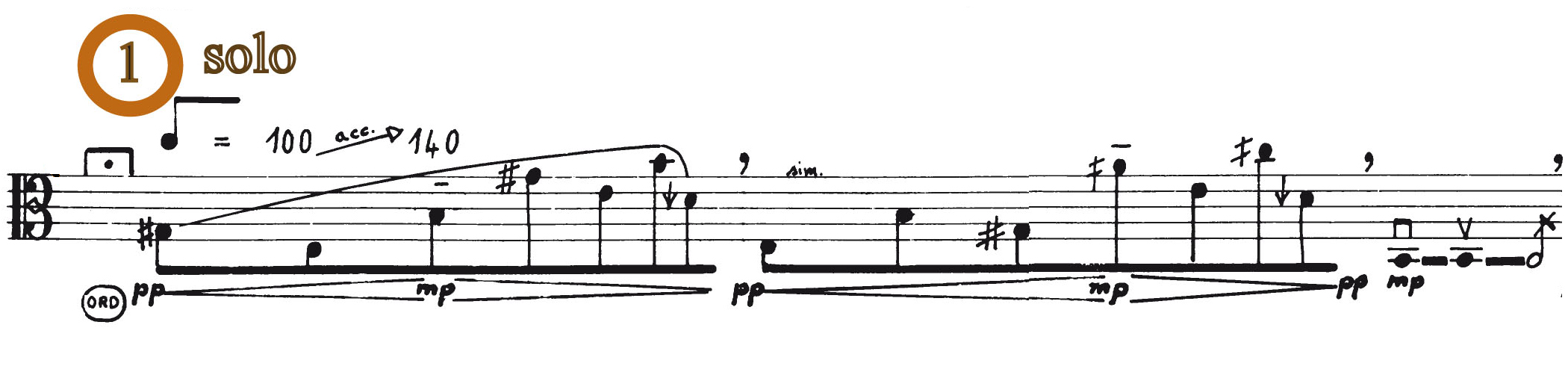
**Figure 9. Excerpt from Prologue featuring the resonance of the ondes Martenot “palme” [© Part. Ricordi, 2005]. **
**Média 5. Natural resonance—Gérard Caussé (viola) [© EA CD Accord, 1993]. **
**Média 6. Virtual resonance—Garth Knox (viola) [© EA CD zeitklang, 2002]. **
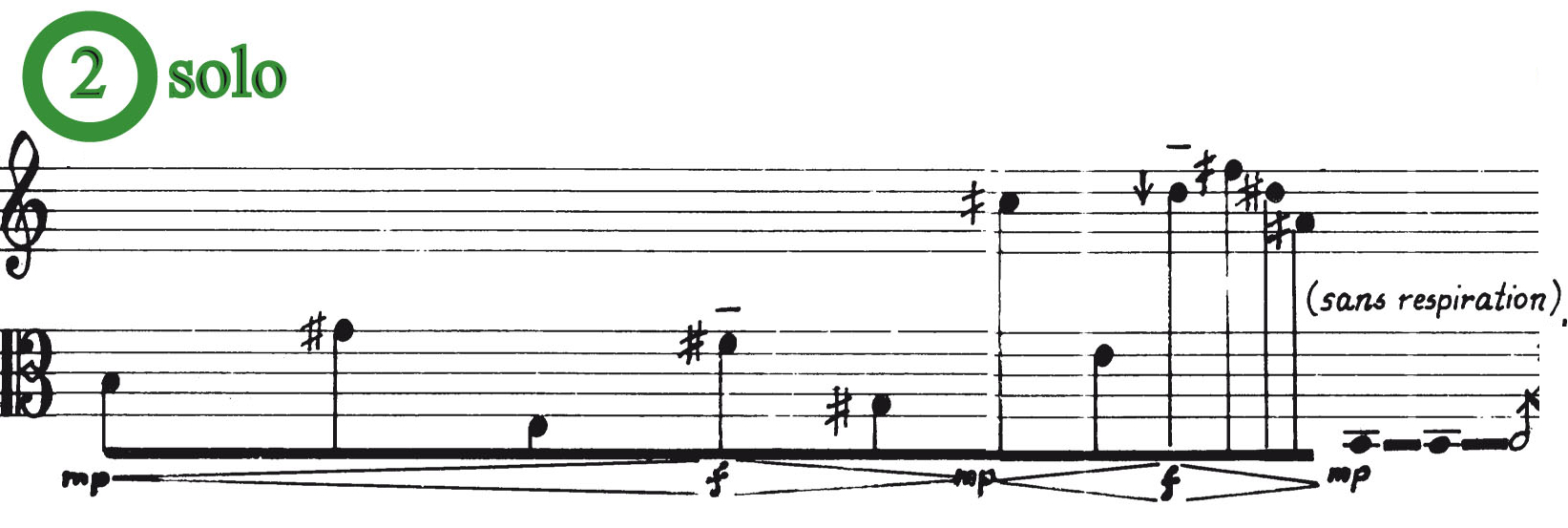
**Figure 10. Excerpt from Prologue featuring the resonance of a grand piano [© Part. Ricordi, 2005]. **
**Média 7. Natural resonance—Gérard Caussé (viola) [© EA CD Accord, 1993]. **
**Média 8. Virtual resonance—Garth Knox (viola) [© EA CD zeitklang, 2002]. **

**Figure 11. Excerpt from Prologue featuring the resonance of a tam-tam [© Part. Ricordi, 2005]. **
**Média 9. Natural resonance—Gérard Caussé (viola) [© EA CD Accord, 1993]. **
**Média 10. Virtual resonance—Garth Knox (viola) [© EA CD zeitklang, 2002]. **
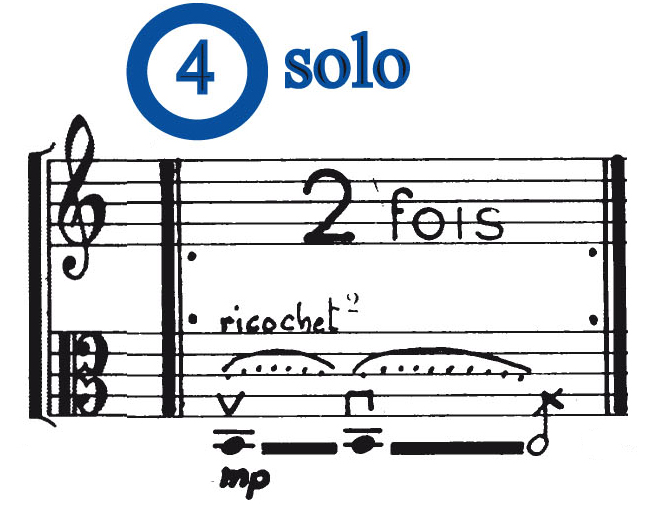
**Figure 12. Excerpt from Prologue featuring the resonance of the ondes Martenot “metallic going” [© Part. Ricordi, 2005]. **
**Média 11. Natural resonance—Gérard Caussé (viola) [© EA CD Accord, 1993]. **
**Média 12. Virtual resonance—Garth Knox (viola) [© EA CD zeitklang, 2002]. **

**Figure 13. Excerpt from Prologue in which the snare drum is audible and the resonances of the “palme,” tam-tam and “metallic gong” are already present [© Part. Ricordi, 2005]. **
**Média 13. Natural resonance—Gérard Caussé (viola) [© EA CD Accord, 1993]. **
**Média 14. Virtual resonance—Garth Knox (viola) [© EA CD zeitklang, 2002]. **
###Analysis of the instrumental score
Prologue is characterised by a progressive transformation of musical cells from harmonic to inharmonic, and ultimately, to noise, an archetype of the spectral aesthetic which numerous composers subsequently explored. Indeed, this timbral axis would become a key element of the musical language of Saariaho [Saariaho, 1991] (cf. the analysis of NoaNoa [Lorieux, 2015]). In the first part of Prologue, the material, which is initially perfectly harmonic, becomes progressively more inharmonic and ends with pure noise. The second part of the work, which is calmer in character, returns to harmonicity.
####Compositional material
Original spectrum
Although Prologue opens the Les Espaces acoustiques cycle, it was composed after Périodes (1974) and Partiels (1975). It reifies the idea of an ambitious cycle running the gamut from solo instrument to large orchestra. The construction of each of the six pieces making up Les Espaces acoustiques is based on a harmonic spectrum with E0 (41.2 Hz) as its fundamental, which Grisey first explored in Périodes (for more information on the genesis of this model, see Féron (2010)). The twelve pitches used by Grisey in that work were the eleven first odd-numbered harmonics (from the fundamental [^NBP2] to 21 inclusive) and the second harmonic [Figure 14]. In order to be “as close as possible to the acoustic reality” [Ricordi, 1974], i.e., to notate pitches which coincide, as far as possible, with the frequencies of the corresponding components of the harmonic series, Grisey used quarter tones for harmonics 11 and 13 and deviations of around a sixth of a tone for harmonics 7 and 21. In Prologue, the fourth string of the viola is lowered by a semitone; as such, the open string sounds B1 (rather than C2), corresponding to the third harmonic of the E spectrum.

**Figure 14. Spectrum which appears in the introductory notes to Périodes and which serves as the basis of all six pieces in the Les Espaces acoustiques cycle [© Ricordi, 1974]. **
This spectrum is more than a mere reservoir of pitches. The 11 numbers at the bottom of the figure (between each harmonic) correspond to the intervals, in quarter tones, between adjacent components. These values, as well as those at the top of the figure—indicating the position of each partial in the harmonic series—played a key role in defining the structure of each of the six works in the cycle. In other words, based on this spectrum, Grisey created three structural series: a sequence of pitches and two numerical sequences. In the interest of clarity, we have assigned a name and an abbreviation for each sequence:
- The series of twelve harmonics (Sh) chosen by Grisey, ranging from the fundamental (E0) to the 21st partial. Non-tempered frequencies in the harmonic series are approximated in the instrumental score using quarter- and sixth-tones.
Sh = [E00, E11, B11, G#22, D↓3↓3, F#33, A𝄲3𝄲3, C𝄲4𝄲4, D#44, F44, G44, A↓4↓4]
- A series (Sn) indicating the positions within the harmonic series of each of the 12 partials listed above.
Sn = [1, 2, 3, 5, 7, 9, 11, 13, 15, 17, 19, 21]
- A series of 11 numbers representing the intervals (in quarter tones) between each adjacent partial (Si). [^NBP3]
Si = [22, 14, 18, 12, 8, 7, 6, 5, 4, 4, 4]
Original “neumes”
The “neumes” in Prologue comprise melodic silhouettes which are characterised by their shape, as opposed to their pitch content, i.e., in each “neume,” the position of a given pitch relative to others forms a distinct shape. “Neumes” are associated with the system of notation used in the Middle Ages; they comprised small melodic formulae applied to a syllable of text, i.e., each neume represented a distinct melodic/rhythmic figure. Indeed, in several of his sketches [Paul Sacher Stiftung], Grisey associated aspects of his neumes with forms from the Middle Ages, such as the clivis (a group of two descending pitches), scandicus (three ascending pitches) and climacus (three or more descending notes).
Grisey created eight neumes made up of between 1 and 13 pitches, all of which are based upon the same unique shape. This “shape” is of key significance, both for the construction of the neumes and in terms of the work’s overall formal structure. The number of pitches in each neume (1, 2, 3, 5, 7, 9, 11 and 13) corresponds to Sn of the original spectrum. As Grisey did in his sketches, here, we have labelled the neumes using roman numerals; this value serves to enumerate the various neumes, but also indicates the number of pitches contained in each.
The various neumes conceived by Grisey are all derived from neume VII; this is evidenced by a fragment from a sketch (below) containing the eight “original neumes” [Figure 15]. Removing the two, four, five and six final pitches from neume VII yields, respectively, neumes V, III, II and I. As for neumes IX and XI, they were constructed in the same manner but using neume XIII as the starting point, which is itself entirely derived from neume VII. Indeed, as this sketch explicitly shows, the six last pitches in neume XIII (H, I, J, K, L and M) correspondent to a retrograde—albeit with a “distorting mirror”—of the six first pitches (A, B, C, D, E, F and G) modelled on neume VII (with the eighth pitch, G, acting as a pivot tone).

**Figure 15. Fragment of a sketch of Prologue in which Grisey defines and enumerates the eight original “neumes” [© Arch. Fondation Paul Sacher]. **
Let’s now consider how the shapes of these neumes attempt to recreate naturalistic models which represent the beating of a heart, an echo and the respiratory cycle.
- Higher order neumes (III to XIII), or the metaphor of the respiratory cycle [Figure 16]
The creation of neume VII was a key point in the compositional process, as it is the basis of all of the other neumes just discussed. Therefore, it would be worthwhile to reflect upon its characteristics and examine the way in which it was created.
Neume VII is based upon the clivis (two descending pitches), the scandicus flexus (two descending pitches and one ascending) and a second clivis. The idea was to transcribe the “ternary” form of the respiratory cycle, which comprises three successive elements: inhalation, exhalation and rest. Grisey had already made use of such a model, notably in Périodes, in which it dictated the formal structure (for more on this, see Féron, 2011). In Prologue, the “inhalation” phase is represented by an ascending melodic motif (the three first notes of the neume), while “exhalation” is illustrated by a descending motif (the four last notes). The rising and descending “breaths” heighten the sensations of tension and release associated with inhaling and exhaling, respectively. The “rest” phase is, as one would expect, represented by silence at the end of the neume.
Neume V is the only one to have exactly the same “silhouette” and dynamic profile as neume VII. In a sense, it symbolises the same respiratory cycle but over a shorter time frame. While the other higher order neumes were also inspired by the respiratory cycle, they are nonetheless distanced to varying degrees from this paradigm. For example, neume III is characterised by a short inhalation, and neume IX by an inhalation–exhalation–inhalation. Neumes XI and XIII are distanced from the respiratory cycle model to such an extent that it is no longer perceptible, owing both to the succession of short inhalation and exhalation phases and the dynamics, which are in opposition to the movement on the vertical axis (i.e., upward melodic motion is generally associated with a “descending” breath, and vice versa).
**Média 15. Neume III—Garth Knox (viola) [© Arch. Ircam—Daubresse]. **
**Média 16. Neume V – Garth Knox (viola) [© Arch. Ircam – Daubresse]. **
**Média 17. Neume VII – Garth Knox (viola) [© Arch. Ircam – Daubresse]. **

**Figure 16. Neumes III, V, VII, IX, XI and XIII from Prologue [© Ricordi, 1978/1992].. **
**Média 18. Neume IX – Garth Knox (viola) [© Arch. Ircam – Daubresse]. **
**Média 19. Neume XI – Garth Knox (viola) [© Arch. Ircam – Daubresse]. **
**Média 20. Neume XIII – Garth Knox (viola) [© Arch. Ircam – Daubresse]. **
- Neumes I and II, or metaphors of a heartbeat and an echo [Figure 17]
!!! attention correction attention attnetion
!!!
Neume I comprises a single, repeated pitch with an iambic (short–long) structure, which is intended to evoke a heartbeat. This rhythmic motif is played on the open fourth string !!! abstract (lowered a semi-tone from standard viola tuning) which corresponds, as we have already mentioned, to the third harmonic (B1) of a harmonic spectrum with E0 as its fundamental. At the performer’s discretion, this figure can be repeated several times in sequence.
Neume II is a clivis (two descending notes) which is systematically grafted onto high-order neumes; accordingly, the two final notes of this neume are repeated several times in order to produce a binary “beating” which is evocative of an echo.

**Figure 17. Neume I (heartbeat; above) and neume II (echo) grafted onto the end of neume XI (below) [© Part. Ricordi, 1978/1992]. **
**Média 21. Neume I – Garth Knox (viola) [© Arch. Ircam – Daubresse]. **
**Média 22. Neume II grafted onto the end of neume XI – Garth Knox (viola) [© Arch. Ircam – Daubresse]. **
####Structure of the piece
_Prologue_is made up of two main parts. The first, which is essentially melodic in nature, represents three quarters of the duration of the piece globally and contains seven sub-sections (1-1 to 1-7). The six first sub-sections are based on the high-order neumes (respectively, by order of appearance, neumes V, III, VII, XI, IX and XIII). The seventh sub-section makes use of glissandi played with excessive bow pressure. As the marking “(VIII fin)” in one of the composer’s sketches implies [Figure 15], this section is based around an eight-note neume which, according to Baillet [2000, p. 105], has been “flattened.”
The second major part of the work, characterised by a return to more subdued material, comprises two sub-sections. Subsection 2-1 is built on held notes which are preceded by short melodic motifs, notated as appoggiaturas, which progressively increase in length and complexity. In sub-section 2-2, these motifs are transformed into glissandi which are performed over a D1 pedal tone; this sub-section is only performed when the work is not succeeded by Périodes; otherwise, the latter work begins at the conclusion of sub-section 2-1 [Figure 20].
Part I
- Organisation of the sub-sections
The neumes described above are treated either (i) as melodic figures (i.e., the high-order neumes) which are subjected to a long and complex process of distortion which unfolds throughout the entire first part of the work, or (ii) as “inserts” (neumes I and II) which appear at certain specific moments, independent of the organisation of the melodic figures. These two typologies undergo transformative processes, which we will describe briefly here. Each section is based on a specific neume, but rather than organising these neumes according to scale, Grisey orders them as follows: V, III, VII, XI, IX, XIII (and VIII). This configuration was not chosen at random; rather, it is intended to recreate the overall “shape” of neume VII [Figure 15] which, as stated previously, represents the formal basis of the work. Each sub-section is associated with an evolutive tempo, be it increasing (i.e., V, VII, XI, XIII) or decreasing (i.e., III, IX) progressively throughout the entire passage in question [Figure 16].
!!! danger Title
!!!
- Transformation of the melodic neumes
In each sub-section, with the exception of the final one, the neumes are repeated a certain number of times while undergoing, with each iteration, increasingly significant modifications, in terms of both their “shape” (or “silhouette”) and their pitch content. In this respect, Grisey applies two separate processes. On one hand, limited permutations occur which serve to alter the starting “shape” of the neume by reverting back to the original shape (for a more detailed explanation of this and other processes applied by Grisey, see Baillet, 2000, pp. 99–112). On the other hand, the pitches are derived from predefined reservoirs which are intended to create the movement away from the harmonicity of the opening figures. Upon “local” processes of transformation (i.e., the permutations unfolding throughout each sub-section) are superimposed global transformative processes (decreasing harmonicity in terms of pitch relationships) which are applied throughout the entire first section.
!!! danger Correct orga insert
!!!
- Organisation of the “inserts”
The “breathing” figures comprising the high-order neumes do not occur in a consistent order; had this been the case, the work may have been in danger of becoming monotonous, even in the presence of the transformative processes described above. In various instances, Grisey includes the two inserts which represent, respectively, a heartbeat and an echo. While seemingly occurring sporadically, their presence is nonetheless dictated by a compositional logic. The “heartbeat” is prominent at the beginning of the piece, appearing with every first, second or third occurrence of neume V in sub-section 1-1, either in isolation or repeated several times. The placement and the number of repetitions are based on the “silhouettes” of the original neumes, i.e., most commonly V or XI. To illustrate this procedure, we will now look at sub-section 1-3 [Figure 18] in which neume VII, as well as the “heartbeat” motif, appear five times, with the latter occurring following two, one, three, five and four occurrences of the former. This numerical sequence (2, 1, 3, 5 and 4) was not arrived at by chance; it corresponds once again to the shape of neume V.

**Figure 18. Section 1-3 of Prologue, which is based on neume VII. The placement of the “heartbeat” insert (shown in red) following 2, 1, 3, 5 and 4 occurrences of neume VII recreates the shape of neume V. The “echo” insert (shown in blue) only appears once in this sub-section [© Part. Ricordi, 1978/1992]. **
**Média 23. Garth Knox (viola) [© Arch. Ircam – Daubresse]. **
As the first section of the work progresses, the “heartbeat” motif occurs less and less frequently whereas the “echo” becomes more prevalent. Although this figure is treated here as an “insert,” it does not occur between repetitions of neumes (in contrast to the “heartbeat”), but rather, is grafted onto them, serving to extend their durations. In such cases, the two final pitches of a neume are repeated several times with a regular rhythm but, with each repetition, a softer dynamic. Grisey added the indication “en écho” in such instances in the score. The placement of this “insert” and its prevalence is subject to the same compositional logic as the “heartbeat.”
- Métaboles
On two occasions, Grisey makes use of métaboles, the term that his professor Olivier Messiaen applied to rhythmic “modulations” or the transformation of one rhythm into another, which Messiaen likened to a cinematic cross-fade effect [Messiaen, 1949-1992/1995, pp. 513-526]. This procedure is applied to alter the rhythmic structures of the neumes which, elsewhere, generally only undergo linear processes of accelerando/rallentando. The métaboles manifest as localised interpolations which “contaminate” the neumes to which to which they are applied with the rhythm of the “heartbeat” motif [Baillet, 2000, p. 111] [Figure 19].

**Figure 19. Two successive instances of neume XI in sub-section 1-4. The first is rhythmically regular, while the second is, by comparison, highly unstable owing to the effect of the métaboles, which is intended to bring the material closer to the iambic “heartbeat” figure [© Part. Ricordi, 1978/1992]. **
**Media 24. Garth Knox (viola) [© Arch. Ircam – Daubresse]. **
Part II
Like the first section of the piece, the second opens with a cell that is repeated ad libitum. The violist performs a glissando, slowly and at a soft dynamic, starting from D1 and ascending a whole tone to E1. With each repetition, the duration of the glissando is shortened, while that of the held E1 increases. The first sub-section of part II [Figure 20] makes heavy use of long, held notes; the pitches are organised according to the “silhouettes” of neumes VII
(G#2 #2, E22, B22, A𝄲3𝄲3, F#2 #2, C𝄲4𝄲4 + F44, Eb3 b3), then V (E33, D33, G# #3, G44 + A44, D#4 #4), and finally III (D#4 #4, B33, A𝄰4𝄰4 + C44) followed by two final intervals played using double stops (A𝄰4𝄰4 + C44, D5(5)5 + C#6 #6). The durations of each cell—indicated in seconds in the score—as well as the number of notes in the appoggiaturas which precede them are, again, based on the original neumes, i.e., in their original form, in retrograde or inverted.

Figure 20. Section 2-1 of Prologue. The arrow at the end of this excerpt indicates the junction point between Prologue and Périodes for instances in which the latter is performed in sequence [© Part. Ricordi, 1978/1992].
**Média 25. Garth Knox (viola) [© Arch. Ircam – Daubresse]. **
!!! danger correct on
!!!
In the final sub-section of the work, Grisey intersperses polar pitch D3 (used in the “heartbeat” figure) with neumes that are now presented as glissandi of harmonics, rendering the neumes barely recognisable relative to their original forms. The polar pitch is repeated eleven times, always following the same decrescendo. The durations of these eleven instances—always given in seconds in the score—are based on the shape of neume 11. The remaining neumes occur once again in reverse order and inverted. The piece ends with ad libitum, quasi-periodic repetitions of a musical cell built on a sustained D: the violist plays a D3 on the fourth string while alternating between open D3 and D4 (played as a harmonic) on the third string, the final heartbeats after a long musical journey.
Analysis of sound processing in the version with real-time electronics
Presentation of the score and patch
To provide instructions regarding the resonances in the piece, Grisey created four overlays for the instrumental score (which are now housed at the Paul Sacher Stiftung in Basel). Based on the information contained therein, and drawing upon the instrumental part [Ricordi, 1978/1992], in 2005, Éric Daubresse created a new version of the score [Ricordi, 2005] which includes information necessary to perform the piece using real-time electronics [Figures 23 to 29]. Daubresse did not make any alterations to the original instrumental part beyond fixing a number of repetitions for each of the three “repeat ad libitum” passages in order to ensure that the instrumentalist and the MLE are consistently able to remain together [Arch. Féron—Interview with Daubresse]. The five resonators and the reverb (if used) are assigned different numbers and colours corresponding to the faders to be adjusted during performance [Figures 21 and 23].
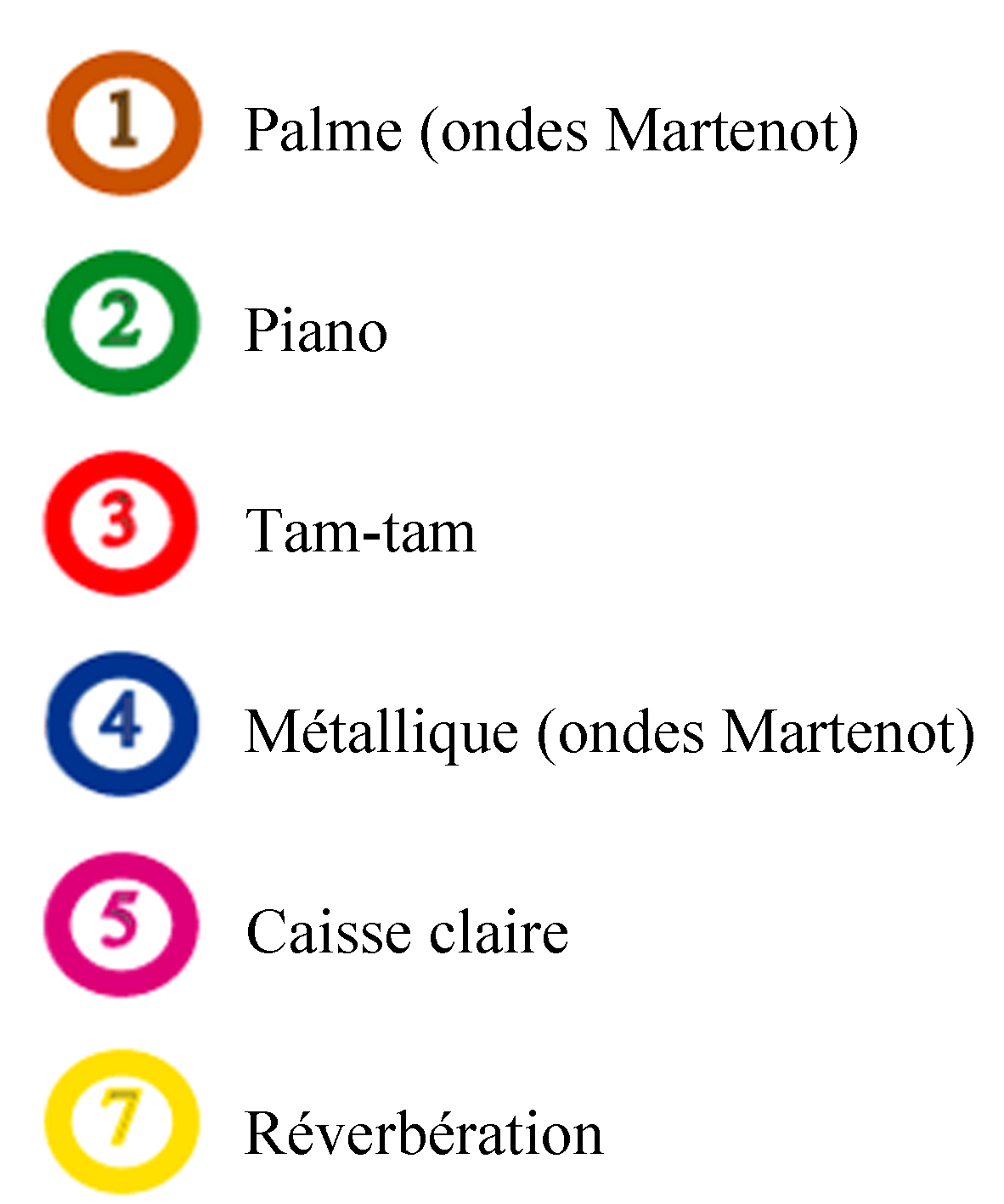
**Figure 21. Colours and numbers associated in the score with the five resonators and reverb. Fader 6 (not shown here) is used to control the volume of the snare drum. **

**Figure 22. Main window in the Max/MSP patch developed by Éric Daubresse at IRCAM in 2001 [Arch. Ircam—Daubresse].. **
Amplification and artificial reverb
In the version created by Daubresse, only after the initial musical cell has been performed twice by the violist is the MLE required to gradually increase the output level of the amplified signal (as well as the reverb, if used) Figure 23]. As noted previously, amplification is intended purely to strengthen the acoustic presence of the viola and maximise fusion of the instrumental sound with the resonances diffused from the rear of the stage. At the end of the piece, the amplification (along with the reverb) must be gradually faded out in order to progressively return to a purely acoustic setting.

**Figure 23. Opening of Prologue: following two instances of neume V and the “heartbeat” figure, the musician overseeing the live electronics gradually fades in the amplification and reverb [© Part. Ricordi, 2005]. **
**Media 26. Garth Knox (viola) [© EA CD zeitklang, 2002]. **
Virtual resonances
Faders 1–5 on the mixing desk control the levels of the signal from the viola to be sent to the virtual resonators. The resonances should not simply appear one after the other in order of decreasing harmonicity; Grisey conceived a series of extremely complex interactions (bordering on virtuosic at times) among the various resonators which often requires adjustments to be made to multiple faders simultaneously.
By moving the faders, it is possible to progressively “activate” or “deactivate” the resonators, as indicated in the score with upward- and downward-pointing horizontal arrows. When a circled number appears directly, this indicates that the corresponding fader should be instantaneously raised to the maximal output position. To indicate that a new resonator should be activated alongside others that are already present, a “+” sign is used. A number followed by the word “solo” indicates that any other resonator which may have been active prior to that moment should be abruptly muted [Figure 24].

Figure 24. Superimposition of and alternance between resonators 1 (“palme”) and 2 (piano) in sub-section 1-3 of Prologue, which is based on neume VII. The indications at the bottom of this excerpt were added by the authors to visually represent the layering in time of the two resonators [© Part. Ricordi, 2005].
**Média 27. Garth Knox (viola) [© EA CD zeitklang, 2002]. **
The “muting” of a given resonator is indicated by a circled number with a cross through it [Figure 25]. However, in order for the score to remain clear and legible, in certain passages, instructions are given in the form of text.

**Figure 25. Superimposition of and alternance among resonators 1 (“palme”), 2 (piano) and 3 (tam-tam) in sub-section 1-4, which is based on neume IX [© Part. Ricordi, 2005]. **
**Média 28. Garth Knox (viola) [© EA CD zeitklang, 2002]. **
There are numerous instances throughout the score in which Grisey wished for interpolation to occur between resonator pairs. In such cases, instructions are provided in the score in the form of colour gradients which indicate that the relevant faders should be progressively raised or lowered simultaneously in order to achieve a metamorphosis from one resonance to another. Such interpolations may involve the use of two resonators [Figure 26] or two resonator pairs [Figure 27]; the latter case, the MLE must take care to avoid the fingers of each hand becoming entangled!

**Figure 26. Interpolation between resonator 2 (piano) and 1 (“palme”) in sub-section 1-5, which is based on neume XI [© Part. Ricordi, 2005]. **
**Media 29. Garth Knox (viola) [© EA CD zeitklang, 2002]. **
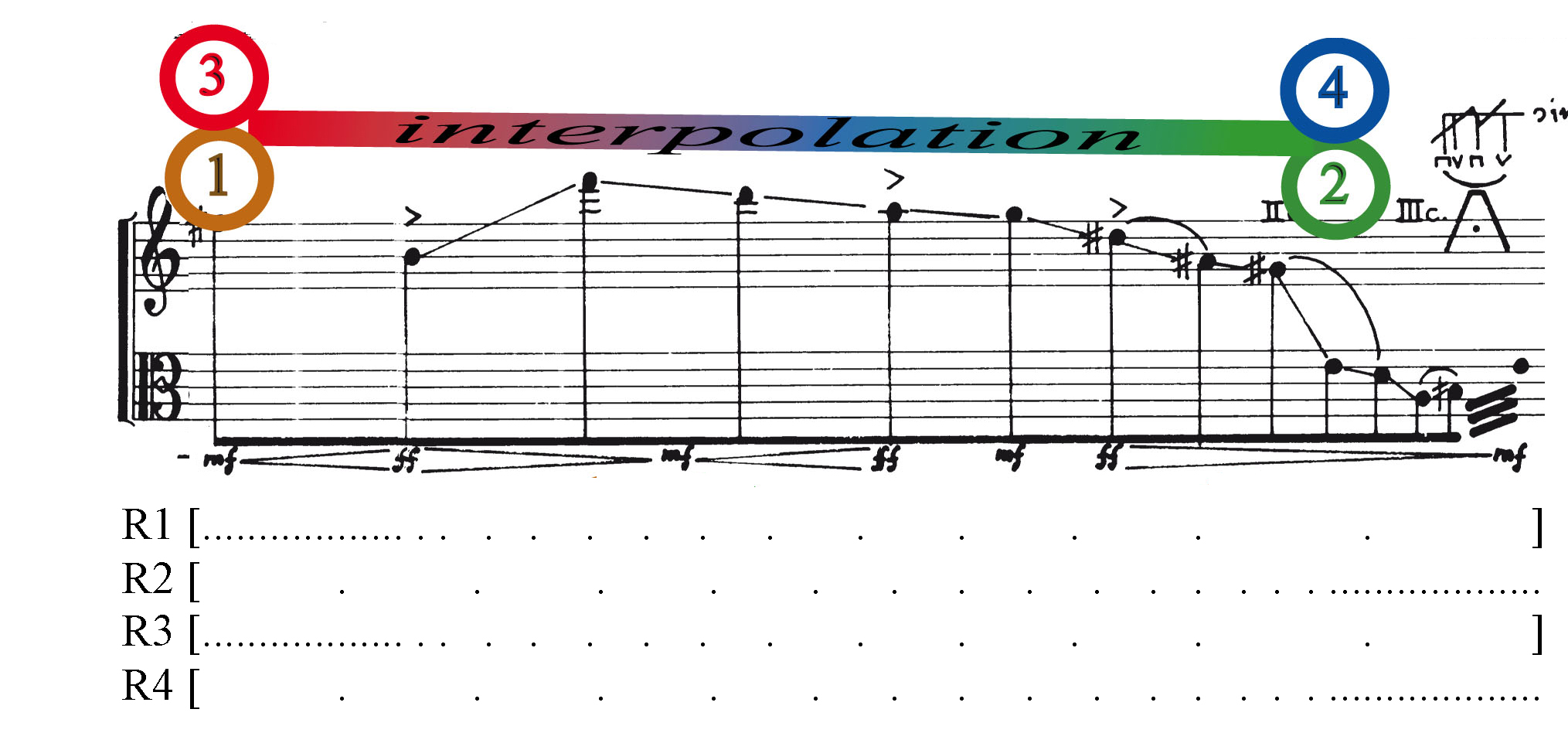
Figure 27. Double interpolation between resonator pairs 1 & 3 (“palme” and tam-tam) and 2 & 4 (piano and “metallic gong”) in sub-section 1-6, which is based on neume XIII [© Part. Ricordi, 2005].
**Media 30. Garth Knox (viola) [© EA CD zeitklang, 2002]. **
As noted previously, the virtual resonance of the snare drum is achieved by the playback of a series of audio samples which are superimposed one upon the other based on the intensity of the incoming signal from the viola. To this end, two faders are used: the first (fader 5) allows the MLE to control the sensitivity of the amplitude follower, i.e., the threshold above which the playback of an additional sample will be triggered, while the second (fader 6) controls the output level of these sounds. Besides occurring briefly in sub-sections 1-5 and 2-2, the snare drum features most prominently at the end of the first section of the work. Although the four other resonators are active at this point, the sensitivity of the amplitude follower is gradually increased, reaching a maximum at the beginning of sub-section 1-7, which corresponds to the noise-driven climax of the instrumental score (double stop glissandi with excessive bow pressure) [Figure 28].

**Figure 28. At the end of sub-section 1-6, the musician responsible for the live electronics slowly increases the sensitivity of the snare drum, and then the output level thereof, reaching a maximum at the work’s climax, which occurs at the beginning of sub-section 1-7 (prolonged use of excessive bow pressure) [© Part. Ricordi, 2005]. **
**Media 31. Garth Knox (viola) [© EA CD zeitklang, 2002]. **
Conclusion
Gérard Grisey’s catalogue contains just three works for solo instruments: Charme (1969) for clarinet, Prologue (1976) for viola and the diptych Anubis-Nout (1983) for contrabass clarinet, which was subsequently arranged for bass or barytone saxophone (1990). Charme is, in the words of the composer, “a work of youth” [Grisey, 2008, p.127], applying serial techniques from which the composer would soon thereafter distance himself. In contrast, as with all of Grisey’s works after 1972, Prologue and Anubis-Nout apply distinctly spectral techniques. These works, which have since become “classics” in the viola and clarinet/saxophone repertoires respectively, reveal the ways in which the composer, at that time, was reintroducing melodic content into his music. Prologue signalled both a return to melodic composition and the birth of the Les Espaces acoustiques cycle (1974-1985).
“When I composed Périodes, I observed that the ending was not an ending, that something had to follow, and thus, I conceived Partiels, which was written immediately afterwards. Since Périodes opened with a solo viola, the idea came to me right away to compose a sort of prologue to this cycle, and little by little, the concept of a large-scale work was born” [Grisey, quoted by Baillet, 2000, p. 70].
In contrast to Épilogue (1985), which cannot be performed without Transitoires, Prologue was originally conceived to be performable in isolation, in one of two versions: for solo viola or solo viola with acoustic resonators. The version with acoustic resonators posed numerous technical problems which limited its viability, and to our knowledge, only Gérard Caussé has performed it, and even then only on five occasions (from 1978 to 1991). In doing away with the need for physical acoustic resonators, the version with real-time electronics, created in 2001 by Éric Daubresse in collaboration with violist Garth Knox, has proven itself to be far simpler to produce. Works of mixed music invariably suffer from problems associated with the gradual obsolescence of the tools required for their performance, making it necessary to constantly create updated versions. Nonetheless, thanks to this new version, the work can be “far more widely performed,” and will occupy “without any doubt the place that it deserves in the canon of contemporary music,” to paraphrase Garth Knox [Notes en blocs 1, 2001].
Ressources
Textes
[Baillet, 2000] – Jérôme Baillet, Gérard Grisey. Fondements d’une écriture, Paris: L’Itinéraire / L’Harmattan, 2000.
[Féron, 2010] – François-Xavier Féron, “Sur les traces de la musique spectrale: analyse génétique des modèles compositionnels dans Périodes (1974) de Gérard Grisey”, Revue de musicologie, vol.96 n°2, 2010, p. 411-443.
[Féron, 2011] – François-Xavier Féron, “The emergence of spectra in Gérard Grisey’s compositional process: from Dérives (1973-74) to Les Espaces acoustiques (1974-1985)”, Contemporary Music Review, vol.30 n°5 “(De)composing Sound”, 2011, p. 343-375.
[Féron et Boutard, 2017] – François-Xavier Féron and Guillaume Boutard, “Instrumentalists on solo works with live electronics: towards a contemporary form of chamber music?”, in Friedemann Sallis, Valentina Bertolani, Jan Burle and Laura Zattra (éd.) Live-Electronic Music. Composition, Performance and Study, Routledge, 2017, p. 101-130.
[Grisey, 2008] – Gérard Grisey, Écrits ou l’invention de la musique spectrale, edition compiled by Guy Lelong with the collaboration of Anne-Marie Réby, Paris: MF, 2008.
[Laurendeau, 1990] – Jean Laurendeau, Maurice Martenot, luthier de l’électronique, Louise Courteau / Dervy-Livres, 1990.
[Levinas, 2002] – Michaël Levinas, Le compositeur trouvère. Écrits et entretiens (1982-2002), texts compiled and annotated by Pierre Albert Castanet and Danielle Cohen-Levinas, Paris : L’Itinéraire / L’Harmattan, 2002.
[Lorieux, 2015] – Grégoire Lorieux, “Analyse de NoaNoa de Kaija Saariaho”, Analyses – Commentaries on works in the IRCAM repertoire.
[Messiaen, 1949-1992/1995] – Olivier Messiaen, Traité de rythme, de couleur, et d'ornitologie, t.2, Paris : Alphone Leduc, 1995.
[Notes en blocs 1, 2001] – “Notes en blocs 1”, concert program for Pauset-Grisey, Ircam-Centre Pompidou, 3 april 2001.
[Plessas et Boutard, 2015] – Peter Plessas and Guillaume Boutard, “Transmission et interprétation de l’instrument électronique composé”, Proceedings of the Journées d’Informatique Musicale, Montréal, 2015.
[Potard et al., 1991] – Yves Potard, Pierre-François Baisnée and Jean-Baptiste Barrière, “Méthodologies de synthèse du timbre : l’exemple des modèles de résonance”, in Jean-Baptiste Barrière (éd.), Le timbre, métaphore pour la composition, Paris : Ircam / Christian Bourgois, 1991, p. 135-163.
[Saariaho, 1991] – Kaija Saariaho, “Timbre et harmonie”, in Le timbre, métaphore pour la composition, Jean-Baptiste Barrière éd., Paris, Ircam / Christian Bourgois, 1991, p. 412-453.
####Archives
[Arch. Féron] — Interviews by François-Xavier Féron with
- Éric Daubresse, 8 November, 2011, in Paris.
- Gérard Caussé, 2 October, 2012, in Paris.
- Patrick Lenfant, 9 November, 2012, by telephone.
[Paul Sacher Stiftung]— Gérard Grisey Collection, “Prologue” dossier, Paul Sacher Stiftung, Basel.
[Ircam Archives—Daubresse]—personal archives of Eric Daubresse housed at IRCAM.
[Ircam Archives—Resources]
- Concert – Gérard Grisey, [Prologue] for viola and real-time electronics, 3 April, 2001, IRCAM.
Garth Knox (viola), Éric Daubresse (computer music designer).
- Atelier-répertoire—Gérard Grisey, Prologue for viola and real-time electronics, 18 January, 2006, Centre Georges Pompidou.
Presentation of the work: Grégoire Lorieux.
Concert: Garth Knox (viola), Éric Daubresse (computer music designer).
- Concert – Gérard Grisey, Prologue for viola, 21 July, 2012. Messiaen Festival, Meije (France), 2012, Église des Cordeliers.
Noémie Bialobroda (viola).
- Concert – for viola and real-time electronics, ManiFeste-2012—Concert of mixed-music works performed by students in the DAI programme at the Paris Conservatoire, and chamber music performed by members of the International Ensemble Modern Academy, 30 June, 2012, Le Centquatre (Paris).
Noémie Bialobroda (viola), Éric Daubresse (computer music designer).
####Partitions
[Part. Ricordi, 1974] – Gérard Grisey, Périodes, Ricordi 132243, 1974.
[Part. Ricordi, 1978/1992] – Gérard Grisey, Prologue, Ricordi 2248, 1978 (re-released in 1992).
[Part. Ricordi, 2005] – Gérard Grisey, Prologue, Ricordi 2248, 2005 (unpublished version with resonators, produced by Éric Daubresse).
####Audio recordings
Version for viola and acoustic resonators
[EA CD Accord, 1993] – Gérard Grisey, Talea; Prologue; Anubis; Nout; Jour, Contre-jour
Ensemble L’Itinéraire, Mark Foster, Pascal Rophé, Gérard Caussé (alto), Claude Delangle
Accord (una corda) 201 952, 1993.
Version viola and real-time electronics
[EA CD Zeitklang, 2002] – Garth Knox, Spectral viola
Garth Knox (alto)
Edition zeitklang ez-10012, 2002.
Version for solo viola
[EA CD AEON, 2009] – Christophe Desjardins, Alto / Multiples
Christophe Desjardins (viola)
AEON AECD 0981, 2009
[EA CD NEOS, 2010] – Ana Spina, Works for viola solo
Ana Spina (viola)
NEOS 10920, 2010.
** The complete Les Espaces acoustiques cycle **
[EA CD Accord, 1999] – Gérard Grisey, Les Espaces acoustiques
Gérard Caussé (viola), Ensemble Court-Circuit / Pierre-André Valade (conductor), Frankfurter Museumorchester / Sylvain Cambreling (conductor)
Accord (una corda) 465 386-2, 1999.
[EA CD Kairos, 2005] – Gérard Grisey, Les Espaces acoustiques
Garth Knox (alto), Asko Ensemble, WDR Sinfonieorchester Köln / Stephan Asbury (direction)
Kairos 0012422KAI, 2005.
###Acknowledgments
I would like to extend my warmest thanks to Éric Daubresse, Gérard Caussé, Patrick Lenfant and Garth Knox for providing me with detailed responses to my numerous questions. I would also like to express my appreciation to Robert Piencikowski, whom I invariably encountered, to my pleasure, during my visits to the Paul Sacher Stiftung in Basel.
**To cite this article: **
François-Xavier Féron, “Gérard Grisey – Prologue”, ANALYSES—Commentaries on works from IRCAM’s repertoire [online], 2016 (revised 2020). URL: https://brahms.ircam.fr/analyses/Prologue/.
[^NBP1]: It is important to draw a distinction between a “Computer Music Designer” (CMD), who contributes to the development of the electronics of a given work, and the musician in charge of operating the live electronics (MLE), who does not necessarily contribute to the creation of the electronics but who is responsible for overseeing their proper execution in performances (for a detailed discussion, see Plessas and Boutard, 2015).
[^NBP2]: As a matter of convention, the first harmonic (f0) corresponds to the fundamental of a spectrum. For a harmonic spectrum, the frequency of each component is in the following relationship to the fundamental: fn = n x f0.
[^NBP3]: Grisey was incorrect here with regard to the first interval. The distance between the fundamental (E0) and the second harmonic (E1) is an octave, or 24 quarter tones, not 22 as he indicated.
Do you notice a mistake?